
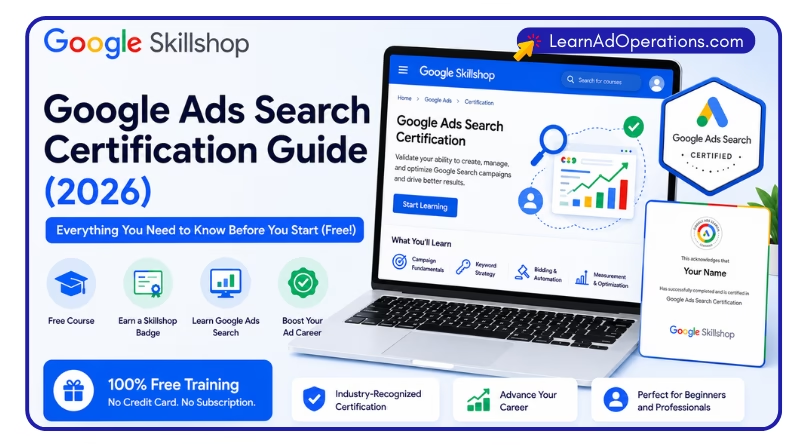
Google Ads Search Certification: Free SkillShop Guide
If there is one certification that keeps coming up on every digital marketing job description, it’s the Google Ads Search Certification. You’ll see it on LinkedIn profiles, resumes, and agency “about us” pages everywhere. And yet, a surprising number of people who could benefit from it haven’t taken it yet – either because they assume it’s complicated, or they just haven’t gotten around to it.
Here’s the thing: it’s completely free. It takes a few hours to prepare. And if you work in digital advertising in any capacity – running campaigns, managing clients, doing ad ops, or just trying to get your foot in the door – it’s one of the most straightforward credentials you can add to your name.
This post covers everything you need to know before you enroll: what the course is, what the exam covers, how hard it actually is, and whether the certification is genuinely worth your time in 2026.
What Is the Google Ads Search Certification?
The Google Ads Search Certification is a free professional credential offered by Google through its official training platform, Google Skillshop. It validates your ability to create, manage, and optimise Google Search Ads campaigns – the text-based ads that appear when someone types a query into Google.
The certification shows an advertiser’s mastery of building and optimising Google Search campaigns, and demonstrates their ability to use automated solutions that boost campaign performance for specific marketing objectives.
In plain terms: it’s Google’s official way of saying, “this person knows how to run Search ads properly.”
Courses on Skillshop mix marketing strategy and product tactics and are built around real-world case studies and common business scenarios, so learners develop actionable marketing and product know-how they can apply right away.
The certification sits within the broader Google Ads certification ecosystem on Skillshop, which also includes certifications for Display, Video, Shopping, and Measurement. The Search certification is typically the one people start with – and for good reason. Search advertising is the foundation that most other Google Ads knowledge builds on.
Who Offers This Certification? A Quick Word on Skillshop
Google Skillshop is Google’s own learning and certification platform. It hosts free training for all of Google’s products – Google Ads, Google Analytics, Google Marketing Platform, Google Ad Manager, and more.
Skillshop helps you develop skills you can apply right away, with e-learning courses designed by Google product experts that you can complete at your own pace.
You don’t need to pay for anything. You don’t need a Google Ads account with active spend. All you need is a Google account – the same one you use for Gmail will work fine – and you’re in.
The platform is available in 22 languages, including English, Spanish, French, German, Japanese, Portuguese, and more. So wherever you’re based, there’s a good chance you can take the course in your preferred language.

What Does the Google Ads Search Certification Course Cover?
This is the part that really matters. Before you sit the exam, Skillshop provides a full Search Advertising Learning Path – a series of training modules that cover everything the exam will test you on.
The Search certification covers the essentials of creating and customising Google Search campaigns that get your ads in front of customers looking for what you offer, along with best practices for keyword and bidding strategies, and ways to boost performance to reach your marketing goals.
Here’s a breakdown of the key topic areas covered across the learning modules:
1. Google Search Campaign Fundamentals
Before anything else, the course walks you through how Google Search advertising works – from the basic structure of a campaign down to the logic of the ad auction. You’ll learn:
- How Google’s search results page is structured and where ads appear
- The difference between organic results and paid search ads
- How the Google Ads account hierarchy works (account → campaign → ad group → keyword/ad)
- Setting campaign goals, budgets, and targeting settings
- How to create your first Search campaign step by step
This foundational section is particularly useful if you’ve used Google Ads before but never fully understood the underlying mechanics.
2. Keyword Strategy and Match Types
Keyword selection is at the core of search advertising. Get it wrong and your ads show to the wrong people. Get it right and you only pay for clicks from people who actually want what you’re offering.
The course goes deep on this topic. You’ll learn:
- Broad Match – the widest net, now enhanced with AI signals including search history, landing page context, and other keywords in your ad group
- Phrase Match – ads show for searches that include the meaning of your keyword
- Exact Match – ads show only for searches that match the exact intent of your keyword
- Negative Keywords – how to block irrelevant searches and protect your budget
The course covers when to use Broad Match versus Exact Match and how to manage Negative Keywords, as well as how to build successful Responsive Search Ads following Google’s latest best practices.
Understanding match types used to be relatively straightforward. In recent years, Google has made significant changes – especially to Broad Match, which now uses machine learning to understand intent rather than just matching words. The Skillshop content reflects these changes, so the training is current and relevant.
3. Responsive Search Ads (RSAs)
Responsive Search Ads are now the default – and only – standard Search ad format in Google Ads. So understanding how they work is non-negotiable.
The course covers:
- How RSAs work: you provide up to 15 headlines and 4 descriptions, and Google’s machine learning tests combinations to find what performs best
- What “ad strength” means and how to improve it
- Best practices for writing headlines and descriptions that work well together
- How to use pinning strategically when certain elements must appear in a specific position
The exam tests how Google’s system rotates and tests RSA combinations for better performance, alongside understanding how Smart Bidding works with broad match to deliver better ROI using real-time signals.
This section also touches on ad assets (formerly called ad extensions) – the additional pieces of information like sitelinks, callouts, structured snippets, and call extensions that expand your ad’s real estate on the search results page.
4. Smart Bidding and Automated Bidding Strategies
This is one of the heavier sections in the course – and one of the most practically useful. Manual CPC bidding is increasingly rare in modern Google Ads management. Smart Bidding, powered by Google’s AI, has become the standard approach for most campaigns.
The course covers:
- The difference between manual bidding and automated bidding
- The full range of Smart Bidding strategies: Target CPA, Target ROAS, Maximize Conversions, Maximize Conversion Value, and Enhanced CPC
- When to use each bidding strategy depending on campaign goals
- How Smart Bidding uses real-time signals – device, location, time of day, search query, browser, and more — to set the right bid for every single auction
The course covers how to optimize with Smart Bidding and forecast ROI with Performance Planner.
Performance Planner gets its own coverage here too – it’s a Google Ads tool that helps you forecast how changes to your campaigns (budget, bids, settings) will affect performance, before you actually make those changes.
5. Quality Score, Ad Rank, and the Ad Auction
Understanding how Google decides which ads to show – and in what position – is fundamental to running Search campaigns well. This section demystifies the ad auction.
You’ll learn:
- Quality Score: a diagnostic tool that estimates the quality of your ads, keywords, and landing pages. It’s based on three factors: expected click-through rate (CTR), ad relevance, and landing page experience.
- Ad Rank: the actual metric Google uses to determine ad position. It’s calculated using your bid, your Quality Score, the expected impact of your ad assets, auction-time context, and ad rank thresholds.
- Why a higher Quality Score can let you achieve better ad positions at a lower cost – and why poor Quality Scores cost you more money for worse results
The course also covers the logic behind Quality Score and how it impacts Ad Rank.
This section often surprises people who assumed Google Ads is purely a bidding war. It’s not. Relevance matters. A highly relevant ad with a great landing page can outrank a higher-bidding competitor with a poor Quality Score.
6. Campaign Optimisation and Optimization Score
Once your campaign is live, the work isn’t over. The course walks you through how to read campaign performance data and make decisions that improve results over time.
Key topics here include:
- Reading key metrics: impressions, clicks, CTR, conversions, conversion rate, CPA, ROAS
- Using the Optimization Score – a 0–100% rating that shows how close your campaign is to its full performance potential, along with specific recommendations for improving it
- How Google’s automated recommendations work and when it makes sense to apply them
- A/B testing ad variations
- Using Search Terms reports to discover what queries are actually triggering your ads, and adding converting terms as keywords or blocking irrelevant ones as negatives
The Google Ads Search Certification converts a brand’s online marketing vision into a coherent digital marketing strategy – including creating targeted campaigns that boost leads, sales, and web traffic.
7. Audience Targeting in Search Campaigns
Search is intent-driven by nature – you’re targeting based on what people are actively searching for. But the course also covers how audience signals can layer on top of keyword targeting to sharpen your results.
Topics include:
- Observation vs. Targeting audience settings and when to use each
- Remarketing Lists for Search Ads (RLSA) – adjusting bids or targeting specifically for people who’ve previously visited your website
- Customer Match – using your own customer data to target or exclude known customers
- In-market audiences and affinity audiences as bid modifiers
The Google Ads Search Certification Exam: What to Expect
Once you’ve worked through the learning modules, it’s time for the exam. Here are the key details you need to know:
| Detail | Information |
|---|---|
| Number of Questions | 50 questions |
| Question Format | Multiple choice and multi-select |
| Time Limit | 75 minutes |
| Passing Score | 80% or higher (you need to get at least 40 out of 50 correct) |
| Retake Policy | If you don’t pass, you can retake after 24 hours |
| Validity | 12 months (you’ll need to renew annually) |
| Cost | Completely free |
The exam consists of 50 questions, requires 80% to pass, and remains valid for 12 months.
A few things worth knowing about the exam format:
The questions are scenario-based. The key focus areas include keyword match types, Responsive Search Ads, Smart Bidding, and Quality Score – and the exam tests practical understanding, not just memorized facts. You’ll be given realistic advertiser situations (a local restaurant launching a campaign, a manufacturer trying to scale ROAS) and asked to choose the best course of action.
The exam is not timed in a stressful way. 75 minutes for 50 questions is roughly 90 seconds per question – which is more than enough if you’ve done the preparation work. Most people finish comfortably within the time limit.
Questions are pulled from a pool. Your assessment will have 50 questions randomly pulled from a pool. So if you retake the exam, you won’t see the exact same questions.
You can’t go back and change answers on some question types, so read carefully before selecting.
How Hard Is the Exam, Really?
Honestly? It’s not the hardest exam you’ll ever take – but it’s not a pushover either.
Beginners should not rush straight into the exam. It is better to go through the learning content carefully and take notes on important concepts, paying close attention to keyword match types, bidding strategies, campaign goals, ad strength, conversion tracking, and optimisation recommendations – areas that often confuse new learners because they combine both marketing strategy and platform knowledge.
The topics that trip people up most often are:
- The nuances between different Smart Bidding strategies (especially Target CPA vs. Maximize Conversions)
- The specifics of how Ad Rank is calculated
- The difference between Observation and Targeting for audiences
- What happens with Broad Match keywords in practice (this has changed significantly with AI)
- How the Optimization Score works and what it does and doesn’t measure
If you’ve been actively managing Google Search campaigns, you’ll likely find the exam quite manageable after a review of the modules. If you’re brand new to Google Ads, budget a bit more time for the learning path – 2 to 4 hours of focused study is realistic before you’re exam-ready.
Start with the official Skillshop lessons before using third-party tutorials. Write down key definitions such as conversions, ad rank, Quality Score, Smart Bidding, and responsive search ads. Practice by creating a dummy campaign structure on paper or in a test account.
Who Should Take This Certification?
The Google Ads Search Certification genuinely serves a wide range of people. Here’s who gets the most out of it:
Digital Marketing Managers and Executives – If you’re overseeing paid search for a brand or business, this certification gives you the vocabulary and framework to make better decisions and have more productive conversations with your agency or in-house team.
PPC Specialists and Media Buyers – This is essentially a requirement for the role. Many job descriptions list it as preferred or required. It also keeps you current, since Google updates its Skillshop content to reflect platform changes.
Ad Operations Professionals – If you work in ad ops and deal with campaign setup, trafficking, or reporting on the SEM side, understanding the underlying campaign mechanics makes your work sharper and your troubleshooting faster.
Freelancers and Consultants – The career value of the certification is usually strongest at the point where someone else has to assess your profile quickly. It works as a signal, not as a guarantee — and for freelancers and independent specialists, trust often has to come before results. A Google certification on your profile helps establish that baseline trust with new clients.
Students and Career Changers – The certification provides the biggest benefit for entry-level positions, where it helps recruiters separate general interest from tested baseline knowledge. If you’re building your first digital marketing resume, this is a very worthwhile few hours to invest.
Business Owners Running Their Own Ads – If you’re handling Google Ads yourself for your own business, this course will almost certainly save you money. Understanding Quality Score, match types, and Smart Bidding means fewer wasted clicks and better campaign performance.
Is the Google Ads Search Certification Worth It?
Let’s be honest about this rather than just saying “yes, absolutely!” like every other guide.
Where it genuinely adds value:
Earning a Google Ads certification sets you apart in the competitive job market. It demonstrates your expertise and commitment to staying updated with the latest Google Ads practices, making you a valuable asset to employers.
Many job recruiters filter resumes that don’t list Google Ads certification. Roles such as PPC Specialist, SEM Analyst, and Digital Marketing Manager often list Google Ads certification as a preferred or required qualification.
For early-career professionals and those pivoting into digital marketing, it’s close to essential. The signal it sends is clear and credible – Google themselves certified you.
Where it has limits:
Experienced employers know that campaign performance matters more than certifications. Real factors that increase value for senior PPC roles include managing large budgets, demonstrating ROAS improvements, and client retention rates. A portfolio showing you improved a client’s ROAS from 2.1x to 4.6x carries more weight than any certification.
In short: the certification opens doors, especially at the beginning of your career or when pivoting into the field. It won’t replace demonstrated performance results – but it wasn’t designed to. Think of it as a baseline signal that gets you taken seriously, not the whole story.
Given that it costs nothing and takes a few hours, the ROI calculation is pretty simple.
How to Enroll: Step-by-Step Guide
Getting started is genuinely easy. Here’s exactly what to do:
- Go to Google Skillshop
Head to skillshop.withgoogle.com – no account creation needed yet, you can browse from here.
- Sign In with Your Google Account
Click “Sign In” and use your Google account. If you plan to use this certification for professional purposes, consider using an email address you’ll maintain long-term – ideally not a temporary work email, since your certifications are tied to that account.
- Navigate to Google Ads
From the Skillshop home, select “Google Ads.” You’ll land on a page showing all available Google Ads certifications and learning paths.
- Select “Google Ads Search”
Click on the Google Ads Search certification. You’ll find the full learning path here – all the training modules alongside the certification exam.
- Work Through the Learning Path First
Before jumping to the exam, work through the training modules. They’re built specifically to prepare you for the exam questions, and they’re genuinely useful beyond just passing the test.
- Take the Certification Exam
When you’re ready, start the assessment. 50 questions, 75 minutes, 80% to pass. You’ll get your result immediately after submitting.
- Download Your Certificate and Add It to LinkedIn
Once you pass, you can download a digital certificate and add the certification directly to your LinkedIn profile’s “Licenses & Certifications” section. It’ll show Google as the issuing organisation, with your certification date.
- Renew Every 12 Months
The certification will be valid for one year and will have an expiry date on the certificate. Once expired, individuals must re-take the assessment to prove their level of knowledge is still up to date. Google updates its Skillshop content regularly, so the renewal process also keeps your knowledge current with platform changes.
Study Tips to Pass on Your First Attempt
A few things that actually help:
Don’t skip the learning modules. They’re specifically designed to prepare you for the exam. Third-party study guides and answer dumps exist, but working through the official content gives you practical knowledge that actually sticks – and you’ll need that knowledge when you’re running real campaigns.
Take notes on the key concepts. Write down key definitions such as conversions, ad rank, Quality Score, Smart Bidding, and responsive search ads. These come up repeatedly in exam questions.
Pay special attention to Smart Bidding. The bidding strategy section is consistently the one that catches people out. Know what each strategy optimises for, when to use it, and what data signals it uses.
Read exam questions carefully. Many questions describe a specific advertiser scenario and ask what the best solution is. The “right” answer is usually the one that most directly solves the specific scenario described – even if another answer looks generally reasonable.
Don’t panic if you fail. You can retake the exam after 24 hours. Use the time to revisit the modules covering the areas you found most difficult.
Frequently Asked Questions
Yes, completely. Google Ads certifications are completely free – you can study and take the exams through Google’s Skillshop platform without paying anything.
The learning path modules can be completed in a few hours. If you’re new to Google Ads, it might take a few days of study. If you’re familiar with the platform, you might be able to pass the exam after reviewing for a couple of hours.
No. Google recommends that you have on-the-job experience using Google Ads and be familiar with online advertising concepts, but you can also prepare by accessing courses in Skillshop. Prior campaign experience helps, but it’s not required.
A minimum of 80% is required, with unlimited retakes available after 24 hours.
12 months. After that, you’ll need to retake the exam to renew it.
Yes. Once you pass, you can add the Google Ads Search certification to your LinkedIn profile’s “Licenses & Certifications” section with Google as the issuing organisation.
Google Ads certifications are available in 22 languages, including French, German, Spanish, Japanese, Portuguese, Korean, Hindi, and more.
our Skillshop account and certifications are tied to your Google account, not your employer. As long as you use a personal or persistently accessible Google account, your certifications remain accessible regardless of where you work.
How the Search Certification Fits Into the Bigger Google Ads Picture
The Search certification is the starting point, but it’s not the only one available on Skillshop. Once you’ve passed Search, here are the natural next steps depending on your role:
| Certification | Best For |
|---|---|
| Google Ads Display | Those working on GDN, audience targeting, retargeting |
| Google Ads Measurement | Ad ops professionals, anyone handling conversion tracking and attribution |
| Google Ads Video | Teams managing YouTube advertising campaigns |
| Shopping Ads | E-commerce specialists and retail marketers |
You can get Google Ads certified across Search, Display, Measurement, Video, and Shopping ads – all through the same Skillshop platform.
For learnadoperations.com readers specifically, the Google Ads Measurement certification is worth mentioning alongside Search. Conversion tracking, attribution models, and Google Analytics integration are core ad ops skills – and that certification covers all of it. We’ll be covering it in detail in a future post.
Final Thoughts: Just Take It
Here’s the honest bottom line: the Google Ads Search Certification is one of the best free learning investments available in digital advertising. The course content is solid, regularly updated, and directly applicable to real campaign work. The exam is challenging enough to be meaningful but achievable with proper preparation. And the credential itself – issued directly by Google – carries genuine weight with employers, clients, and collaborators.
The only wrong move is putting it off.
Whether you’re just starting out in digital marketing, brushing up on Google’s latest AI-powered features, or adding another credential to a growing certifications list, this one is worth a few hours of your time.
Ready to start? Head to Google Skillshop → Google Ads → Google Ads Search Certification.
At LearnAdOperations.com, we break down free digital advertising courses so you can make smart decisions about where to invest your learning time. We’ve already covered the Microsoft Advertising Learning Lab – Free Programmatic Course – check it out if you work on the programmatic or display side of advertising.


