CPC Explained: Formula, Benchmarks and Optimization Guide
You are running ads, and money is leaving your account every hour. The single metric that tells you if your investment is working efficiently is your CPC, or Cost Per Click. It is one of the most frequently checked metrics in digital advertising, and understanding how to calculate and leverage it is non-negotiable for paid media professionals.
What Is CPC (Cost Per Click)?
CPC stands for Cost Per Click. It is the average amount you pay every time a user clicks your advertisement. While the concept is simple in theory, in practice, CPC is the foundational number that shapes your overall campaign budget, your bidding strategy, and your Return on Ad Spend (ROAS).
Almost every major advertising platform utilizes CPC as a core billing or bidding model. Google Ads, Meta Ads, LinkedIn Ads, and Microsoft Ads prominently feature this metric in their dashboards because it provides a direct, easy-to-interpret signal of how efficiently your ad translates impressions into actual traffic.
The CPC Formula: How to Calculate Your Ad Costs
Calculating your cost per click requires a very simple equation. The universal CPC formula is:
Total Ad Spend ÷ Total Clicks = CPCFor example, if your total ad spend is $500 and your campaign generated 400 clicks, your CPC is $1.25. That amount is exactly what each visit to your landing page cost your business. Whether that $1.25 is a strong metric depends entirely on what the user does after the click, which ties directly into conversion rate optimization.
CPC Calculator
Cost Per Click · Ad Operations Tool · learnadoperations.com
How to Use a CPC Calculator (Step-by-Step)
- Calculate CPC
Input: Total Spend + Clicks
Output: Cost per click
Use case: Performance analysis - Calculate Budget
Input: Target CPC + Expected Clicks
Output: Required budget
Use case: Campaign planning - Calculate Clicks
Input: Budget + CPC
Output: Estimated clicks
Use case: Traffic forecasting
How to Maximize a CPC Calculator
A robust CPC calculator typically offers three modes to cover the most common scenarios encountered in day-to-day ad operations:
- Calculate CPC: Enter your total spend and total clicks to determine exactly what each click cost. Use this mode after pulling data from your ad platform to effectively benchmark your performance.
- Calculate Budget: Enter your target CPC and expected clicks to back-calculate the budget you will need. This is highly useful for planning a new campaign before it goes live.
- Calculate Clicks: Enter your fixed budget and a known CPC benchmark to project how many clicks you can realistically expect to generate from that spend.
Each of these modes is designed to answer specific questions at different stages of a campaign lifecycle, including planning, monitoring, and reporting.
Why CPC Matters in Day-to-Day Ad Operations
If you work in ad operations, media buying, or performance marketing, CPC is an omnipresent metric. Here is exactly where it matters most in practice:
Campaign Pacing and Budget Management
Knowing your average CPC allows you to pace your campaign spend with confidence. If your daily budget is $100 and your historical CPC is $0.50, you should expect approximately 200 clicks per day. When that number suddenly dips or spikes, it signals a change in your bid, audience, competition, or ad quality.
Bid Strategy Decisions
On platforms like Google Ads, your maximum CPC bid directly influences your ad rank and display frequency. Monitoring your actual CPC against your maximum CPC reveals if you are leaving money on the table or overpaying. A large gap between the two often indicates you can afford to lower bids or target more competitive keywords.
Performance Benchmarking
CPC benchmarks vary significantly by industry. For instance, legal and finance keywords on Google Search can reach $20 to $50 per click, while e-commerce ads on Meta might sit around $0.50 to $2.00. Understanding your industry’s average CPC provides a vital baseline. If you are significantly above the industry average, your quality score, relevance score, or creative quality might need improvement.
ROAS and Profitability Calculations
CPC feeds directly into your profitability calculations. If your CPC is $2, your landing page converts at 3%, and your average order value is $60, you are spending $200 to generate $180 in revenue—meaning you are losing money. Changing one of those variables shifts the entire picture, and CPC is usually the variable you have the most direct control over.
CPC vs. CPM: Understanding the Difference
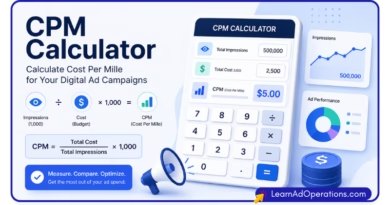
A very common question among marketers is the difference between CPC and CPM. CPM (Cost Per Mille) is the amount you pay per 1,000 impressions, regardless of whether anyone clicks on the ad. CPC is the amount you pay only when a user actually clicks.
For direct-response campaigns aimed at driving traffic to a landing page, CPC bidding typically makes more sense because you are paying for actual user intent. Conversely, CPM tends to be more effective for brand awareness campaigns where overall reach and visibility are prioritized over clicks. Understanding both models helps you make smarter bidding decisions.
Common CPC Benchmarks by Platform (2025–2026)
These figures represent cross-industry averages. Your actual CPC will fluctuate based on specific audience targeting, creative quality, industry competitiveness, and chosen bidding strategies.
| Advertising Platform | Average CPC (All Industries) | Key Notes |
| Google Search Ads | $2.32 – $5.26 | Costs have steadily risen; competitive verticals like legal and B2B SaaS frequently see CPCs between $8.00 and $50.00+. |
| Google Display Ads | $0.63 – $0.67 | Remains highly cost-effective for brand awareness and retargeting, though it features a significantly lower Click-Through Rate (CTR) than Search. |
| Meta Ads (Facebook/IG) | $1.35 – $3.56 | Facebook averages around $1.35 to $1.88, while Instagram commands a premium, often averaging closer to $3.56 per click. |
| LinkedIn Ads | $5.26 – $6.00+ | The most expensive platform for clicks, though targeting C-suite executives or senior decision-makers can quickly push CPCs to $10.00–$15.00+. |
| Microsoft/Bing Ads | $1.34 – $1.54 | Continues to offer excellent cost efficiency, frequently averaging 30–40% lower in cost per click compared to Google Search while capturing an older, higher-income demographic. |
5 Actionable Tips to Lower Your CPC
A lower CPC is not automatically better, but if you are paying more than necessary, here is where you should look to optimize:
- Improve Quality Score (Google Ads): Creating higher relevance between your keyword, ad copy, and landing page will directly reduce your CPC.
- Tighten audience targeting: Showing your ads only to people who are highly likely to click and convert improves your CTR. This improved CTR subsequently reduces your CPC on most platforms.
- Use negative keywords: Filtering out irrelevant search queries immediately stops wasted ad spend. This also drastically improves your overall click quality.
- Test ad creative regularly: A higher-performing creative asset generates more clicks at the exact same bid. This effectively lowers your CPC without requiring you to change your maximum bid.
- Adjust your bidding strategy: Manual CPC provides tighter control over your spend. Automated strategies, such as Target CPA or Maximize Clicks, can become more efficient once your account has gathered enough conversion data.
Frequently Asked Questions (FAQs)
It depends entirely on your industry and what you are selling. A $5 CPC might be excellent for a B2B SaaS tool with a $500 monthly contract, but it would be terrible for a $15 e-commerce product. The more important metric is your cost per conversion, as CPC is just one input into that broader equation.
When advertising platforms report “Avg. CPC,” they are showing the average cost across all your clicks over a specific period. This average can mask outliers; some clicks might have cost $0.30 while others cost $4.00. Evaluating your CPC by specific keyword, ad group, or placement provides a much more accurate picture.
Not necessarily. A very low CPC can sometimes indicate low-quality traffic, resulting in clicks that do not convert. You must always pair your CPC analysis with your conversion rate and ROAS data to understand the full performance picture.
Yes. The fundamental CPC formula is universal. It works exactly the same whether you are analyzing Google Ads, Meta Ads, LinkedIn, TikTok, or Programmatic platforms.
Conclusion: Taking Control of Your Cost Per Click
Understanding and optimizing your Cost Per Click (CPC) is more than just a routine mathematical exercise – it is the foundation of profitable digital advertising. Whether you are launching a new Search campaign or scaling Meta ads, your CPC dictates your budget pacing, influences your bidding strategy, and ultimately determines your Return on Ad Spend (ROAS).
By continuously monitoring your CPC, benchmarking it against industry standards, and actively applying optimization strategies – such as improving your Quality Score, utilizing negative keywords, and refining your audience targeting – you ensure that every advertising dollar works harder for your business.
However, remember that a lower CPC is only truly valuable if those clicks drive meaningful actions. Always evaluate your click costs in tandem with your conversion rates and revenue data to ensure you are acquiring high-quality traffic, not just cheap clicks.
Ready to streamline your campaign math? Take the guesswork out of your ad spend by using our complete suite of Ad Operations KPI Calculators. From calculating your CPC and CPM to forecasting your target ROAS, our free tools are built to help you optimize faster and make smarter, data-driven decisions.