CPM Calculator: Calculate Cost Per 1,000 Impressions Fast
CPM (Cost Per Mille) is one of the most fundamental KPIs in digital advertising. Whether you are planning a programmatic display campaign, running social media ads, or managing a direct buy with a publisher, knowing how to calculate CPM accurately can directly impact how you allocate budget, benchmark performance, and report results to clients or stakeholders.
This free, interactive CPM Calculator lets you solve for any variable — CPM rate, total budget, or total impressions — in seconds. Below the CPM Calculator, you will find a complete guide on what CPM means, how to use the formula, industry benchmarks, and how it fits into your day-to-day ad operations workflow.
CPM Calculator
Instantly calculate Cost Per Mille, Total Budget, or Impressions for your digital ad campaigns.
Industry CPM Benchmarks (2025)
What Is CPM in Digital Advertising?
CPM stands for Cost Per Mille, where "mille" is the Latin word for thousand. In digital advertising, CPM refers to the cost an advertiser pays for every 1,000 impressions their ad receives. An impression is counted each time an ad is displayed on a screen, regardless of whether the user clicks on it or not.
CPM is primarily used in awareness-focused campaigns where the goal is reach and visibility, rather than direct conversions. It is the dominant pricing model in:
- Programmatic display advertising (DSPs, SSPs)
- Social media advertising (Facebook, Instagram, LinkedIn, Twitter/X)
- Video advertising (YouTube, CTV/OTT platforms)
- Direct publisher deals and sponsorships
- Native advertising networks
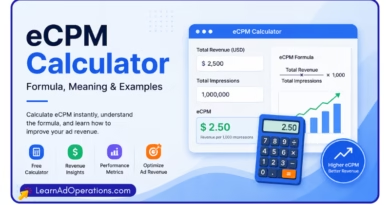
Quick Example: If your campaign served 500,000 impressions and you spent $2,500, your CPM is $5.00. That means every 1,000 eyes on your ad cost you five dollars.
The CPM Formula Explained
There are three versions of the CPM formula, depending on what you need to solve for:
1. Calculate CPM (Most Common)
CPM = (Total Budget ÷ Total Impressions) × 1,000Use this when you know your spend and impressions and need to report the effective CPM of a campaign.
2. Calculate Total Budget
Total Budget = (CPM ÷ 1,000) × Total ImpressionsUse this when planning a campaign. If a publisher quotes you a $7 CPM and your target is 2,000,000 impressions, you can calculate the exact budget required before signing an IO.
3. Calculate Total Impressions
Total Impressions = (Total Budget ÷ CPM) × 1,000Use this to forecast reach. Given a fixed budget and a known or estimated CPM, this tells you how much inventory your budget can buy.
How to Use the CPM Calculator
The calculator above has three modes — simply click the tab for what you want to find:
- Find CPM
Enter your Total Budget and Total Impressions. Click Calculate to get your effective CPM.
- Find Budget
Enter a CPM rate and your target impression volume. The calculator returns the exact budget you need.
- Find Impressions
Enter your available budget and an estimated CPM. Get the projected impressions your campaign can deliver.
All results format automatically with currency and comma separators. You can also use the Enter key to calculate quickly without clicking the button.
CPM in Day-to-Day Ad Operations: Practical Use Cases
CPM is not just a billing metric — it is an operational lever that ad ops professionals use across the campaign lifecycle. Here is how it shows up in daily workflows:
📋 1. Pre-Campaign Budget Planning
Before a campaign launches, ad ops and media planners use CPM benchmarks to build media plans. If you are working on a branding campaign with a $50,000 budget and expect a $6 CPM on programmatic display, you can project roughly 8.3 million impressions for the client. Setting accurate expectations before a campaign starts is critical for client satisfaction and delivery planning.
📊 2. Campaign Performance Reporting
During and after a campaign, you will calculate eCPM (effective CPM) to report how efficiently the budget was spent. Comparing planned CPM vs. actual eCPM helps identify delivery issues, poor targeting, or audience saturation early.
🤝 3. Publisher and Platform Rate Negotiations
When negotiating a direct IO (Insertion Order) with a publisher, CPM is the central pricing term. Knowing industry benchmarks by channel — and being able to counter-model alternative CPMs with forecasted impressions — gives you negotiating leverage. Use the "Find Budget" and "Find Impressions" modes of this calculator to run quick scenarios mid-conversation.
🔄 4. Comparing Channels and Campaigns
CPM allows you to normalize costs across channels that use different pricing models. For example, you might run a CPC campaign on Google Search alongside a CPM campaign on Display. By calculating the effective CPM for each, you can compare the cost of visibility on an apples-to-apples basis.
⚡ 5. Troubleshooting Underspend and Overspend
If a campaign is underspending, one lever is the bid/CPM ceiling. Programmatic platforms allow you to set a max CPM bid. Understanding the relationship between your CPM, available inventory, and win rate helps you diagnose delivery pacing issues quickly and make informed bid adjustments.
📈 6. Forecasting Reach for Awareness Campaigns
For brand awareness and upper-funnel campaigns, reach (unique users) and frequency are the primary success metrics. CPM, combined with frequency caps, helps estimate net unique reach. If you are targeting 1 million unique users with a 3x frequency cap, your required impressions are 3 million — and your budget can be reverse-calculated from the expected CPM.
CPM vs. CPC vs. CPL vs. CPA: When to Use Each
CPM is one of several pricing and performance models in digital advertising. Knowing when to apply each metric is essential for accurate measurement:
| Metric | Full Name | Best Used For | Formula |
|---|---|---|---|
| CPM | Cost Per Mille | Brand awareness, reach, video views | (Budget ÷ Impressions) × 1,000 |
| CPC | Cost Per Click | Traffic generation, consideration | Budget ÷ Clicks |
| CPL | Cost Per Lead | Lead gen, form fills, sign-ups | Budget ÷ Leads |
| CPA | Cost Per Acquisition | Conversions, purchases, ROI-focused | Budget ÷ Conversions |
| eCPM | Effective CPM | Publisher revenue, blended reporting | (Revenue ÷ Impressions) × 1,000 |
In most full-funnel campaigns, you will track all of these metrics simultaneously — CPM for upper funnel, CPC for mid-funnel, and CPA for lower funnel conversions.
CPM Benchmarks by Channel (2024)
CPM varies significantly by platform, industry vertical, audience, and ad format. The benchmarks below represent average industry ranges — actual CPMs may be higher or lower based on targeting, competition, and seasonality (Q4 typically sees 20–40% higher CPMs due to holiday advertiser demand).
| Platform / Channel | Average CPM Range | Notes |
|---|---|---|
| Facebook / Instagram | $5 – $10 | Higher for narrow audiences |
| $25 – $35 | B2B, professional targeting premium | |
| Google Display Network | $2 – $5 | Highly variable by vertical |
| YouTube (Video) | $4 – $10 | Skippable vs. non-skippable differ |
| Programmatic Display | $0.50 – $3 | Open exchange; PMPs are higher |
| CTV / OTT | $15 – $40 | Premium inventory, household reach |
| Twitter / X | $4 – $8 | Varies with political cycles |
| $2 – $5 | Strong for e-commerce verticals | |
| TikTok | $6 – $12 | Rising CPMs with platform growth |
Source: Aggregated industry reports and platform benchmarks. Values reflect approximate 2024 averages and may vary.
Frequently Asked Questions About CPM
A "good" CPM depends entirely on the channel and campaign objective. For programmatic display, a CPM under $3 is generally efficient. For LinkedIn B2B campaigns, $25–$35 CPMs are standard. Always benchmark against your specific channel and vertical rather than a universal target.
CPM is the rate you pay or are charged. eCPM (effective CPM) is a retrospective calculation of what you actually paid per 1,000 impressions after a campaign runs, or what a publisher earned per 1,000 impressions served. eCPM is often used in publisher monetization reporting to normalize revenue across different deal types.
Standard CPM counts all ad served impressions, including those that may not have been seen by a user (e.g., ads below the fold). vCPM (viewable CPM) is a newer metric that only counts impressions that were actually viewable per IAB viewability standards (at least 50% of the ad in view for 1+ second for display; 2+ seconds for video).
CPM is driven by supply and demand in ad auctions. During high-demand periods like Q4 (Black Friday, holiday season), more advertisers compete for the same inventory, which drives CPMs up. During slower quarters like Q1, CPMs typically drop as advertiser budgets reset and competition decreases.
Yes — CPM is a universal cost-per-impression benchmark across all paid media. You can directly compare the CPM of a Facebook campaign to a programmatic display campaign to understand the cost of reach on each platform, even though the audiences and placements are different.
Conclusion
CPM is a foundational metric every ad operations professional, media buyer, and digital marketer needs to understand deeply. It is not just an invoice line item - it is a planning tool, a performance diagnostic, and a negotiation lever rolled into one.
Bookmark this CPM Calculator for your daily workflow. Whether you are pricing a publisher deal, projecting campaign reach, or reconciling a post-campaign report, having accurate CPM math at your fingertips saves time and prevents costly errors.