eCPM Calculator: Formula, Meaning and Examples
If you run ads on your website – or manage campaigns for a client – you have probably seen the term eCPM sitting quietly in your reporting dashboard. It does not shout for attention like CTR or conversions do. But in many ways, it is the most honest number in ad monetisation. This post breaks down exactly what eCPM means, shows you the formula, and gives you a free eCPM calculator to run the numbers yourself.
What is eCPM in Digital Advertising?
eCPM stands for Effective Cost Per Mille (mille being Latin for thousand). It measures your actual revenue earned per 1,000 ad impressions, across all your monetisation channels combined. Unlike a standard CPM – which is a fixed rate agreed before a campaign runs – eCPM is a calculated result. It reflects what you actually earned, not what was promised.
Think of it this way. You might have direct-sold inventory running at a $10 CPM, programmatic fill at $3 CPM, and a house campaign filling remnant inventory at $0.50 CPM. None of those numbers alone tells you how well your ad stack is performing overall. Your eCPM does, because it rolls all of those into one unified metric.
eCPM vs RPM – Are They the Same Thing?
Almost. RPM (Revenue Per Mille) is the term Google uses in AdSense and Google Ad Manager to describe the same concept. The difference is subtle: RPM is sometimes calculated on page views rather than impressions, depending on the platform. For most practical ad ops purposes, eCPM and RPM are interchangeable – both tell you revenue earned per thousand units served.
The eCPM Formula
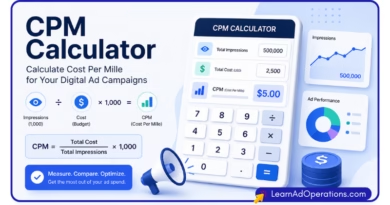
The math is straightforward. Here is the core eCPM formula:
eCPM = (Total Revenue ÷ Total Impressions) × 1,000So if your site earned $250 from 500,000 impressions in a given month:
eCPM = ($250 ÷ 500,000) × 1,000 = $0.50That means you earned 50 cents for every 1,000 impressions served. Whether that is good or bad depends entirely on your vertical, ad format, and audience quality – but now at least you have a single number you can track, benchmark, and improve.
You can also flip the formula to find your projected revenue or the impressions you need to hit a revenue target. The calculator below handles all three variations.
eCPM Calculator
Use the free tool below to calculate eCPM, estimate revenue from a known eCPM, or work out how many impressions you need to hit a revenue goal. Switch between modes using the tabs.
How to Use This eCPM Calculator
The calculator has three modes. Here is when to use each one:
- Find eCPM
This is the most common use case. Enter your total revenue and total impressions for a given period – a day, a week, a month – and the tool gives you your eCPM. Pull these numbers from your ad server, Google Ad Manager, or any SSP dashboard. Make sure both figures cover the exact same time window or the result will not be meaningful.
- Find Revenue
If you already know your eCPM (from a benchmark, a deal rate, or past performance), you can project revenue for a given impression volume. This is useful for forecasting – for instance, before pitching a direct-sold campaign or setting a monthly monetisation target.
- Find Required Impressions
Working backward from a revenue goal. Enter your target eCPM and the revenue you want to generate, and the calculator tells you how many impressions you need to serve. This is especially handy for traffic planning, content strategy, or capacity discussions with your ad ops team.
eCPM vs CPM – What Is the Actual Difference?
This is where a lot of people get tripped up. They look similar on paper, and the formulas share DNA. But they describe very different things.
| CPM | eCPM | |
|---|---|---|
| What it is | A pricing model — what an advertiser agrees to pay per 1,000 impressions | A performance metric — what a publisher actually earned per 1,000 impressions |
| Set by | Advertiser or media buyer | Calculated from actual revenue data |
| When used | Before a campaign runs (planning, bidding) | After a campaign runs (reporting, analysis) |
| Who cares most | Advertisers and agencies | Publishers and ad ops teams |
| Includes all ad sources? | No — single line item or deal | Yes — blended across all demand sources |
The short version: CPM is a rate. eCPM is a result. A publisher can have a single premium deal running at $20 CPM and still have a low eCPM if the fill rate is poor or the rest of their inventory is undermonetised.
Why eCPM Matters in Day-to-Day Ad Operations
eCPM is one of those metrics that looks simple on the surface but carries a lot of operational meaning when you dig in. Here is how ad ops teams use it regularly:
Benchmarking Demand Partners
When you run multiple SSPs or ad networks, eCPM lets you compare them on equal footing. If Partner A has a higher average CPM but lower fill rates, their actual eCPM contribution may be lower than Partner B. Without eCPM, you are comparing apples to oranges.
Monitoring Monetisation Health
A sudden drop in eCPM is often the first signal that something is wrong – a broken ad tag, a blocked demand source, seasonal budget pullbacks, or a policy issue. Tracking eCPM daily gives you an early warning system before a revenue dip becomes a real problem.
Evaluating New Ad Formats
Thinking about testing outstream video or interstitials? eCPM gives you a clean way to compare performance against your existing display inventory. A new format that earns $8 eCPM versus your current $2 eCPM from banners is hard to argue against – even if its fill rate is lower.
Reporting to Stakeholders
Non-technical stakeholders (content teams, editorial, finance) do not always understand fill rate, win rate, or floor pricing. eCPM is a single, intuitive number that translates ad performance into language everyone can follow. “$4.20 eCPM this month, up from $3.80 last month” says a lot without requiring a degree in ad tech.
How to Improve Your eCPM
There is no single lever you can pull. Improving eCPM usually involves working on a few areas at the same time:
- Improve viewability. Ads that are not seen do not earn well. Moving ad placements above the fold or using sticky formats typically increases viewability rates — and viewable CPMs are significantly higher than non-viewable ones.
- Increase demand competition. Adding more SSPs and demand partners to your header bidding stack increases auction competition, which pushes eCPM up. More buyers = higher bids.
- Set intelligent floor prices. Too low and you leave money on the table. Too high and fill rate drops, dragging eCPM down. Use historical data to find the sweet spot for each placement.
- Improve audience quality. eCPM is directly tied to the value advertisers place on your audience. First-party data signals, contextual alignment, and niche authority all contribute to higher bids from DSPs.
- Optimise ad load and layout. Placing too many low-quality ads on a page can reduce the CPM of premium placements through cannibalization. Sometimes fewer, better-placed ads result in a higher overall eCPM.
- Refresh creatives strategically. Ad refresh can boost impression volume but may lower per-impression CPMs if done too aggressively. Monitor eCPM before and after enabling refresh to find the right cadence.
eCPM Benchmarks by Ad Format
eCPM benchmarks vary widely by geography, vertical, device type, and audience. The figures below are rough industry reference points for desktop display in the US market. Mobile and international numbers will differ significantly.
| Ad Format | Typical eCPM Range (US, Desktop) | Notes |
|---|---|---|
| Standard Display (300×250) | $0.50 – $3.00 | Lower due to high supply volume |
| Leaderboard (728×90) | $0.80 – $3.50 | Above-the-fold placements perform best |
| Large Rectangle (300×600) | $2.00 – $8.00 | Higher attention value, fewer units per page |
| Outstream Video | $5.00 – $15.00 | Significantly higher due to video CPMs |
| Interstitial / Adhesion | $3.00 – $12.00 | High viewability drives premium rates |
| Native Ads | $1.50 – $6.00 | Context-dependent; content-adjacent performs well |
These are starting points, not targets. Your actual eCPM depends on your specific audience, traffic source (organic vs. paid), time of year (Q4 is almost always the highest), and how well your ad stack is set up.
FAQ – Common eCPM Questions
Not necessarily. A very high eCPM with extremely low fill rate may generate less total revenue than a moderate eCPM with 90% fill. You want to optimise for total revenue, and eCPM is one input into that equation — not the entire story. Always look at eCPM alongside impression volume and fill rate together.
Yes. eCPM is format-agnostic. Whether you are monetising through video pre-rolls, native units, sponsored content, or audio ads, the formula is the same. It is one of the few metrics that lets you compare performance across completely different ad types side by side.
There is no universal answer. A finance or insurance publisher in the US can see eCPMs of $20–$50+ because advertisers in those verticals bid aggressively. A general lifestyle blog might sit at $1–$4. The most useful benchmark is your own historical data — track your eCPM week over week and month over month, and focus on improving your own trend rather than chasing an industry average that may not apply to your situation.
Final Thoughts
eCPM is one of those metrics that gets more useful the more consistently you track it. It is not a vanity number – it is a signal. When eCPM climbs, something in your ad stack is working better. When it drops, something needs attention. The calculator above gives you an instant way to run the numbers without spreadsheets. Bookmark it and use it as a quick sanity check alongside your regular reporting.
If you want to go deeper on the tools and concepts behind ad monetisation, explore the rest of the LearnAdOperations.com resource library – it is built for anyone who works in or around ad ops, from beginners to people who have been in the industry for years.